
FRAMEWORK //
INTENT CONVERSION MECHANICS
The NDA Model: Mapping Need, Deliberation, and Action
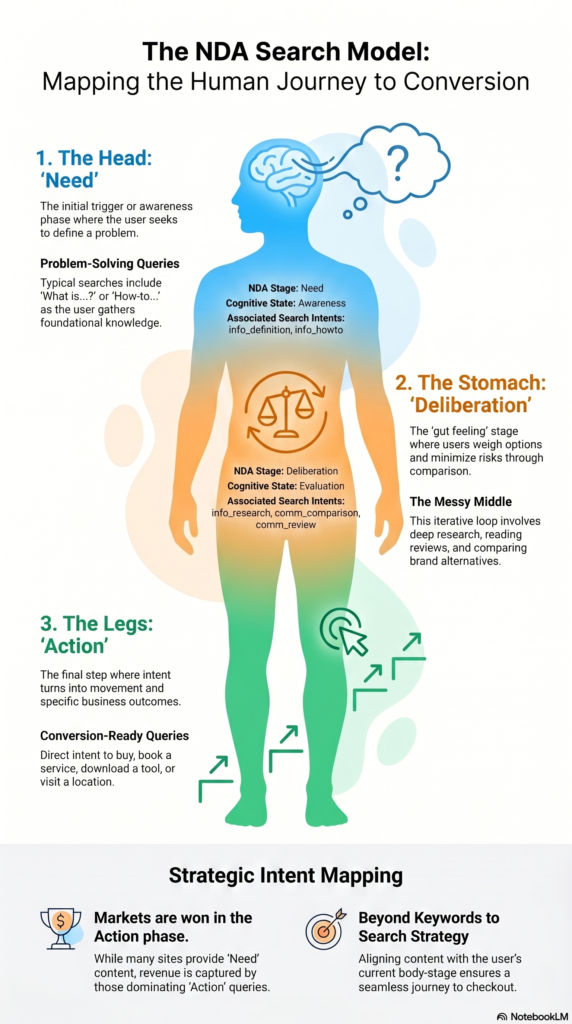
1. Phase N: Triggering the Core Need
Every commercial journey begins with an initial trigger—the Need phase. Inside this organic entry point, the user’s cognitive load is highly chaotic. They are exploring entities, defining problem structures, and expanding their search horizons.
Traditional SEO architectures treat this phase as a mere high-volume traffic play, flooding the subdirectory with low-intent content slop. The NDA Model, however, uses userLOVE to anchor these early informational vectors. We map the entry-level query clusters not just to gain fleeting visibility, but to prepare the mathematical skeleton for the user’s inevitable cognitive pivot.
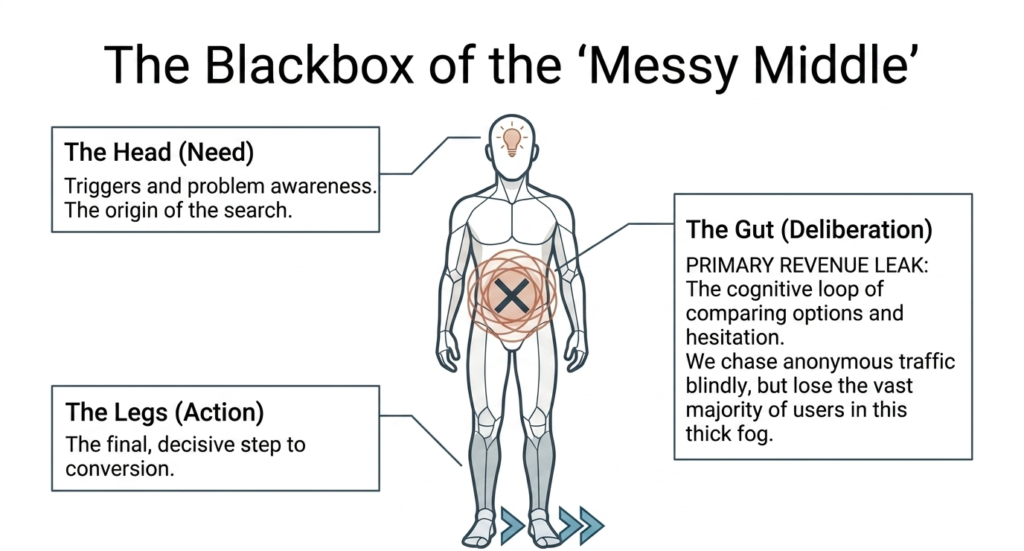
2. Phase D: Dominating the Deliberation Loop (The Trust Gap)
The absolute critical failure point for enterprise platforms occurs during the transition into the Deliberation phase. Here, the buyer stops researching the problem and begins evaluating specific solutions, calculating operational risk, and seeking structural proof.
This is where the “Belly of Trust” opens up, and where traditional marketing revenue bleeds out completely. If your asset fails to present explicit validation—such as precise comparative models or verifiable data metrics—the session immediately fractures. Through contentLOVE, we deploy calculated trust elements directly into this deliberation loop, closing the gap and eliminating cognitive friction before the user can bounce to a competitor.
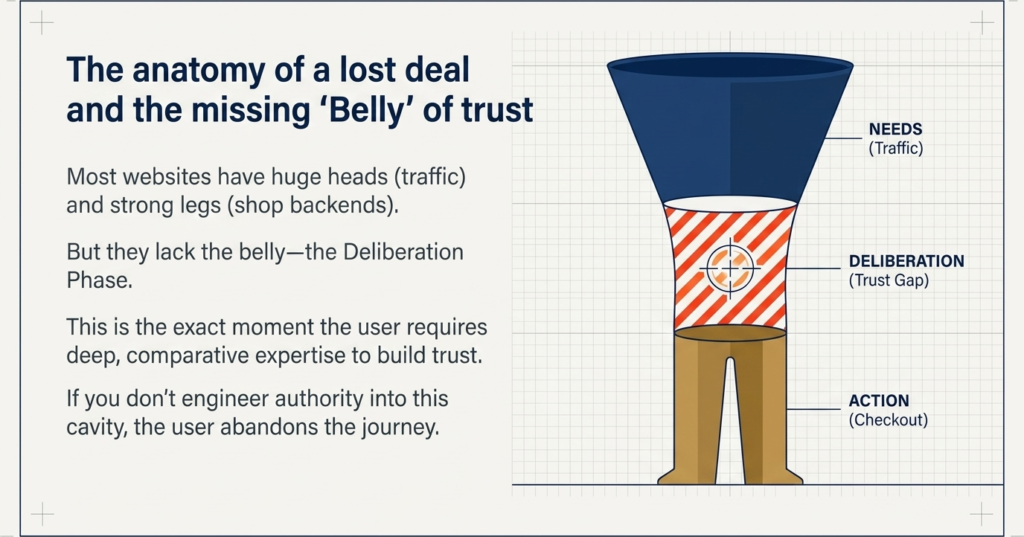
3. Phase A: Forcing Deterministic Action
Once the Deliberation phase is mathematically satisfied, the prospect enters the final vector: the Action phase. In legacy funnels, brands pray that a user clicks a generic Call-to-Action. In our framework, action is a deterministic certainty.
Because the user journey has been structured through high-integrity relational nodes via relationLOVE, moving toward the transaction becomes the path of least resistance. The transaction isn’t a forced marketing push; it is the natural mathematical conclusion of a journey cleared of all semantic doubt.
4. The Compound ROI of Phase Integration
Isolating marketing campaigns into siloed keyword lists creates endless operational expense (OpEx). Integrating the complete NDA matrix into a single, unified enterprise subfolder creates a self-sustaining CapEx asset. By capturing the buyer at the initial Need, anchoring them through deep Deliberation, and executing predictable Action, you build an unyielding digital monopoly that consistently lowers acquisition costs as the network scales.

searchneedsLOVE //
ARCHITECTING NDA STATE TRANSITIONS
With the complete mechanics of Need, Deliberation, and Action mapped, proceed to explore the economic layer in Why CAC Collapses when Intent is Dominated or request a structural infrastructure audit.
Architecting Permanent Digital Revenue.
Immediate live deployment. Annual corporate terms apply.
Deep Dive
Framework Article
- Search Architect
The financial architecture of traffic assets.