
FRAMEWORK //
SYSTEM CONVERGENCE
The Convergence of Systems:
Why LLM Retrieval and Google Search Follow the Same Mathematics

1. The Core Theorem:
High-Dimensional Vector Mapping
Agencies sell separate optimization packages for search crawlers and AI chatbots, creating unnecessary operational complexity. At their structural core, both systems operate on the exact same mathematical foundation: embeddings and vector similarity.
Whether a user submits a 2-word keyword query or a complex 50-word prompt, retrieval engines translate the input into a mathematical coordinate within an Intent Space. The engine’s sole objective is to locate the most dense, semantically aligned informational nodes to construct or retrieve an answer.

2. Deconstructing Google:
RAG in the SERP
Google has completed its evolution from string-matching algorithms to deep vector retrieval. Powered by transformer models like Gemini and MUM, Google’s AI Overviews do not simply crawl pages—they execute a classic Retrieval-Augmented Generation (RAG) pipeline directly inside the SERP:
Retrieval: Sweeping the index for candidate documents with high Authority Density within the vector space.
Extraction: Extracting isolated factual nuggets and relational entity matrices.
Synthesis: Generating a consolidated response while injecting forced citations to verified primary sources.
3. The Behavioral Amplifier:
NavBoost & Chrome Clickstream
While isolated LLMs rely heavily on static model weights and single-pass RAG, Google introduces a critical secondary layer: NavBoost. Powered by real-time clickstream data from billions of Chrome sessions, NavBoost measures human validation (pogo-sticking, dwell time, query reformulation).
LLM Penalty: An isolated LLM simply ignores low-density, superficial content during RAG extraction.
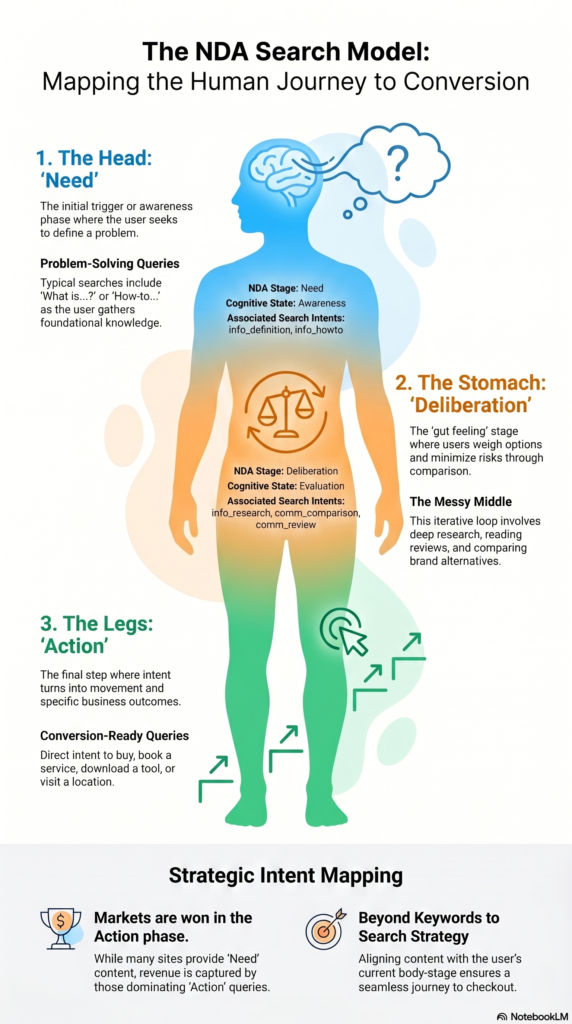
Google Penalty: Google extracts the factual nugget, but if the user bounces back to the SERP due to a weak “Action” phase, NavBoost systematically demotes the entire subdirectory.
Conclusion: Google’s margin for error is significantly smaller—making high-integrity, dense content architecture a non-negotiable prerequisite for both ecosystems.
4. Eliminating Intent Cliffs
via Matrix Coverage
Traditional SEO fails because it leaves structural “Intent Cliffs”—gaps in content depth where a user is forced to leave the domain to finalize their deliberation.
By deploying deterministic matrix coverage across the entire Deliberation phase, searchneedsLOVE ensures that every semantic requirement is satisfied natively on your subfolder. This enforces a Citation Constraint on AI Overviews and LLMs while satisfying Google’s NavBoost behavioral scoring simultaneously.

searchneedsLOVE //
DETERMINISTIC VECTOR DOMINANCE
Systems are converging toward vector-based intent retrieval. To see how our closed infrastructure transforms this mathematical reality into permanent corporate equity, explore the Intent Dominance Pyramid.
Architecting Permanent Digital Revenue.
Immediate live deployment. Annual corporate terms apply.
Deep Dive
Framework Article
- Search Architect
The financial architecture of traffic assets.