
FRAMEWORK //
SYSTEM CONVERGENCE
The Death of Topical Authority:
How AI Slop & Intent Pollution Ruined SEO
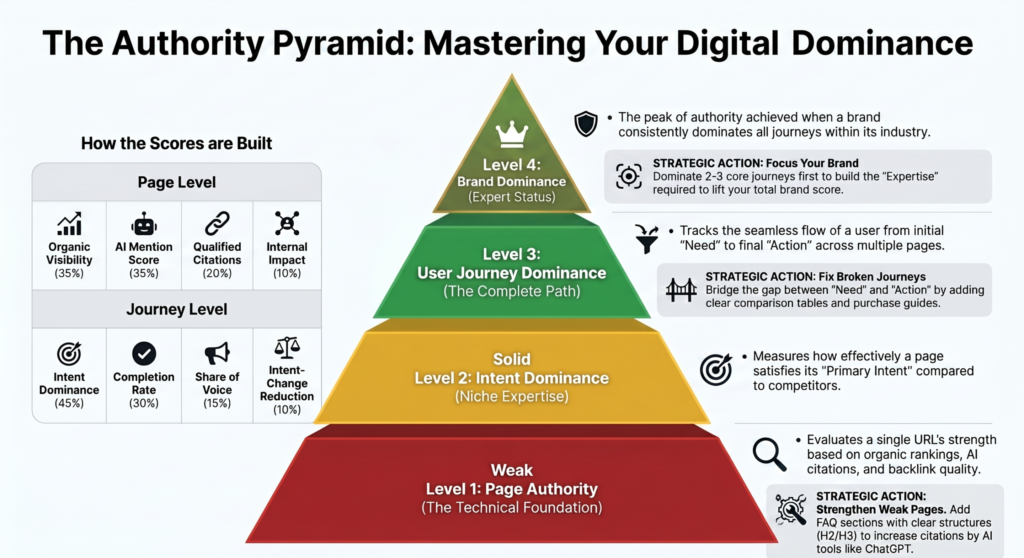
1. The Fallacy of Topical Authority:
Brute-Force SEO
Topical Authority was never a precise architectural strategy; it was a statistical brute-force tactic. The traditional approach dictated creating 200–500 static articles around a topic cluster, assuming a naive, linear user journey from blog post to product purchase.
This worked historically because Google’s legacy algorithms relied on topical coverage as a proxy for relevance. Brands were not guiding decisions—they were merely casting a massive, low-quality net over the search engine results page (SERP).
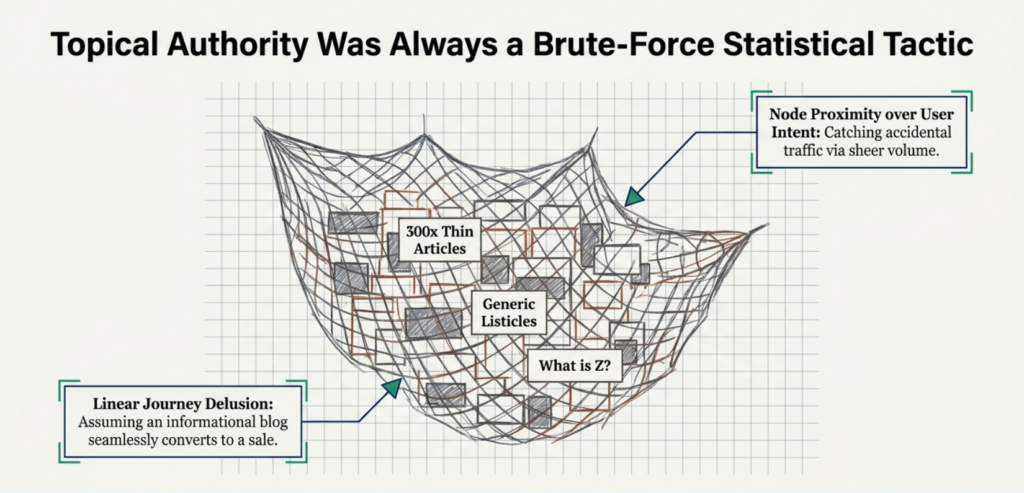
2. The AI Slop Factory & "Intent Pollution"
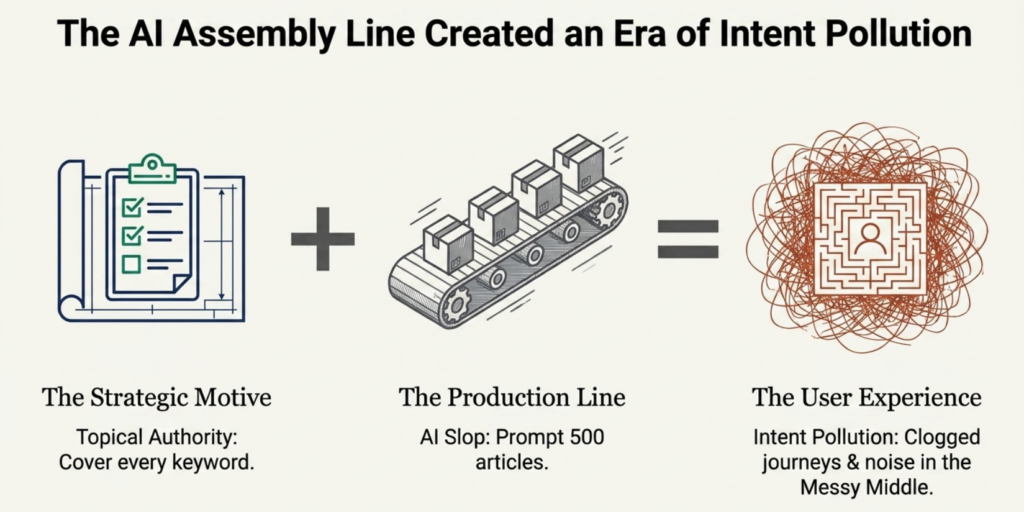
When Large Language Models emerged, Topical Authority became the strategic motive, and Generative AI became the industrial factory floor. The web was flooded with synthetic, unverified fluff.
Intent Pollution occurs when the Deliberation Phase—where buyers evaluate options and weigh risks—is clogged with interchangeable, LLM-generated noise. Real buyers looking for empirical validation are forced to wade through paragraphs of fluff, destroying brand trust before a transaction can take place.
3. The Double Anvil:
Algorithmic & Generative Collapse
Domains relying on scaled Topical Authority face an existential double-squeezing mechanism:
1. Algorithmic Collapse (Google Search): Through aggressive enforcement against Scaled Content Abuse and Site Reputation Abuse, Google is systematically deindexing synthetic topic clusters.
2. Generative Collapse (RAG & Zero-Click): If content survives Google’s filters, it falls into the RAG Trap. LLMs (ChatGPT, Perplexity, Google AI Overviews) ingest thin theoretical knowledge, synthesize final answers in the chat window, and route zero traffic to your domain.
4. Commercial Betrayal:
The Amazon Switch
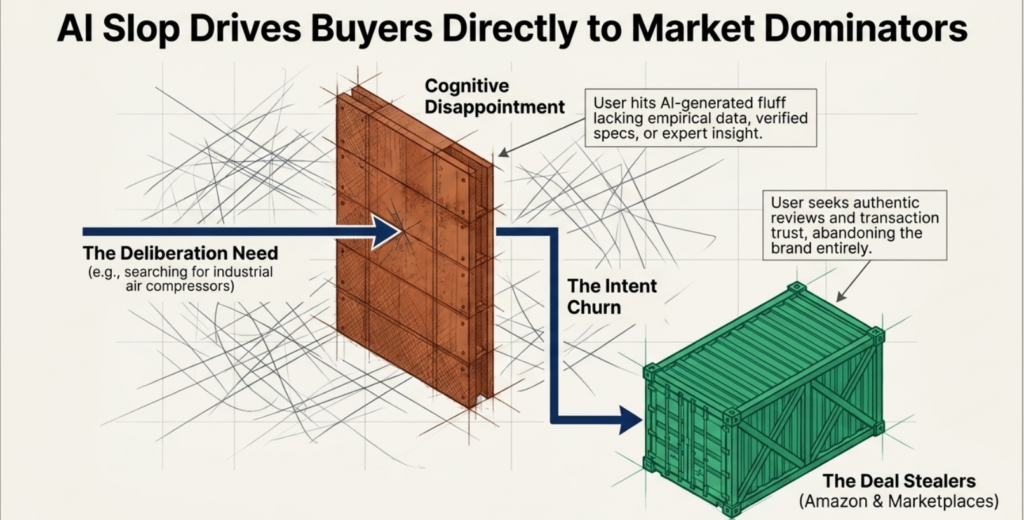
The worst fallout of AI Slop isn’t lost rankings—it’s capital destruction. When a buyer encounters generic AI-generated articles on a brand’s site during their Deliberation phase, they experience immediate cognitive disappointment.
Seeking real reviews, verified specs, and transactional safety, the buyer abandons the brand and executes the purchase on Amazon or third-party marketplaces. Brands are actively paying agencies to generate content that hands their hot leads directly over to marketplace monopolies.
5. The New Paradigm:
Intent Dominance & Authority Density
To build permanent digital equity, organizations must transition from static node coverage to Intent Dominance.
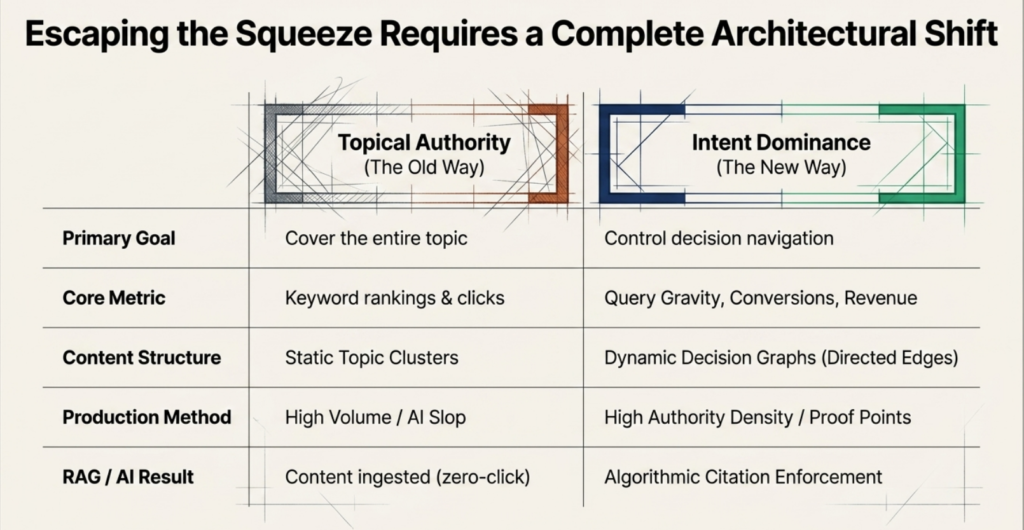
Topical Authority (Old)
Intent Dominance
6. The Three Mechanics of Intent Dominance
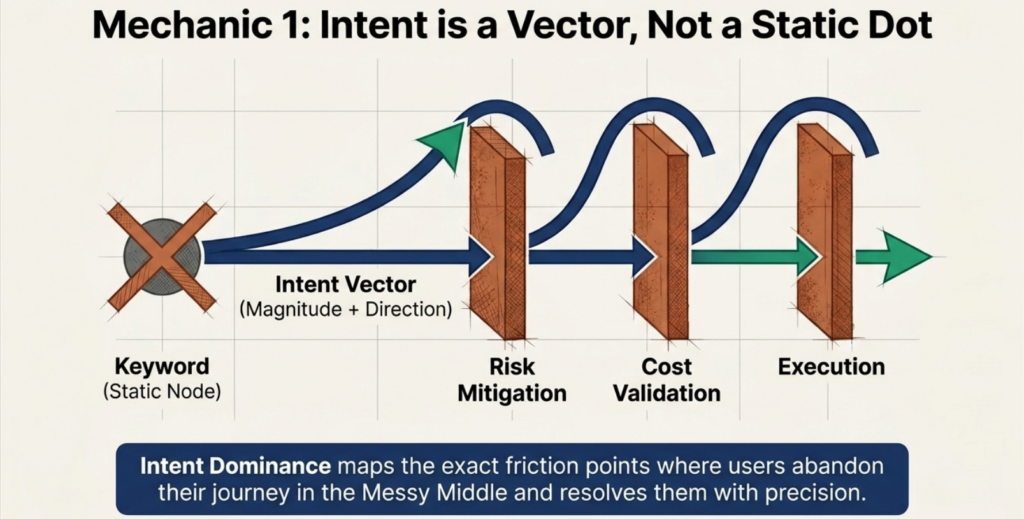
Dynamic Decision Mapping (Directed Edges): Mapping the exact micro-friction points in the Messy Middle where users typically abandon their journey, and resolving them natively.
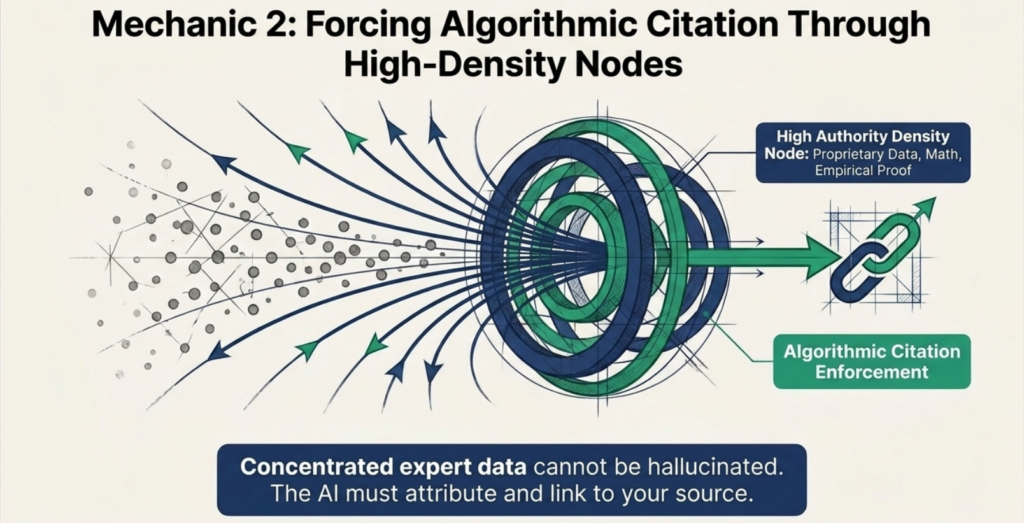
Authority Density (Forcing LLM Citation): Concentrating expert data and mathematical proof points into concise nodes. High density forces RAG systems into Algorithmic Citation Enforcement.
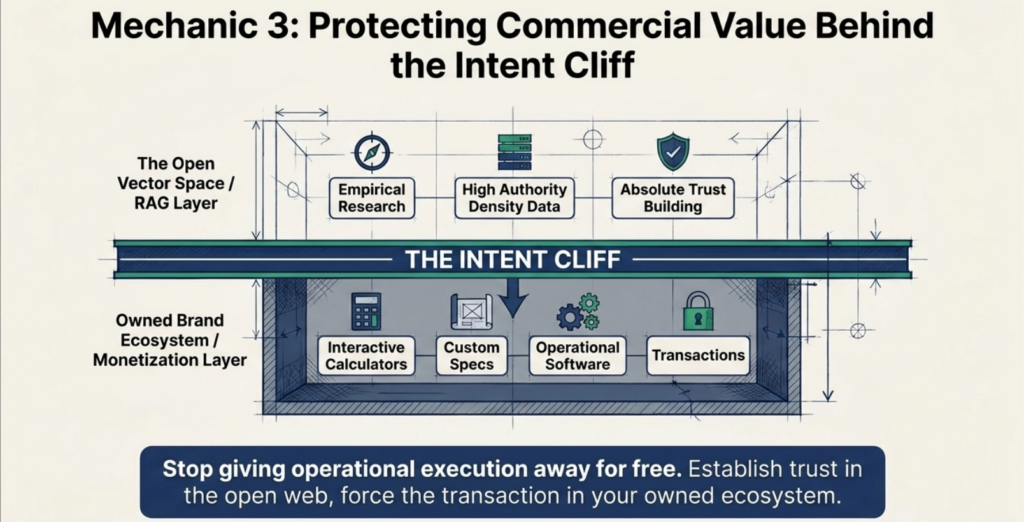
The Intent Cliff: Establishing absolute trust on the open web with theoretical skeletons, while securing interactive tools, calculators, and operational software behind the Intent Cliff inside your owned ecosystem.
searchneedsLOVE //
STOP FUNDING THE DEAL STEALERS
Ready to audit your subdirectory for Intent Pollution and establish true Authority Density? Transition to the Intent Dominance Pyramid or consult with our Revenue Architects.
Architecting Permanent Digital Revenue.
Immediate live deployment. Annual corporate terms apply.
Deep Dive
Framework Article
- Search Architect
The financial architecture of traffic assets.
Question & Answer
Defending the Legacy: Hard Questions from the Establishment
Google’s algorithms have always rewarded comprehensive topical coverage. If I don't build 200+ sub-pages covering every micro-topic and W-question in my niche, how can Google possibly recognize my domain as an authority?
The Reality Check: You are confusing Node Quantity with Authority Density.
In the pre-generative era, Google used topic coverage as a crude proxy for authority because it lacked vector-level semantic mapping. Today, Google's algorithms (alongside LLMs) evaluate the mathematical density of unique information on a page, not the sheer volume of HTML documents.
Flooding your site with 200 sub-pages created from the same underlying data pool creates redundant vector noise. Under Google’s updated Scaled Content Abuse policies, this strategy is classified as Intent Pollution.
A single page with high Authority Density carries more weight in modern semantic vector spaces than an entire 100-page bloated topic cluster.
Can’t we just build a dedicated 'Grounding Page' with rich Schema markup to act as the Single Source of Truth (SSOT) for LLMs and force them to use our entities correctly?
The Reality Check: Anyone who believes a single "Grounding Page" will act as an authoritative Single Source of Truth for Large Language Models fundamentally misunderstands how LLMs and RAG systems operate.
LLMs are not relational databases executing SQL queries; they are probabilistically driven vector spaces. You cannot force entity alignment through self-referential metadata on a single document.
An entity is defined in vector space by semantic consensus, cross-verification, and high Authority Density across the entire graph.
If your "Grounding Page" is surrounded by generic vector noise (AI Slop), RAG engines will score your chunks poorly during Top-K retrieval, override your self-declared definitions, and draw answers from higher-density third-party nodes. You do not ground an LLM with a single page; you ground it with mathematical Intent Dominance across the full decision journey.
We don't just dump raw ChatGPT text! We use advanced prompting, human editing, and programmatic workflows to scale our topic clusters. Isn't AI-assisted Topical Authority completely safe?
The Reality Check: You are polishing AI Slop, but it remains slop.
Editing a synthetic article does not magically inject original empirical research, proprietary software logic, or real-world transactional proof points. If an LLM can generate 90% of your article's substance from its training weights, your content possesses zero defensive moat.
Whether written by a junior copywriter, a prompt engineer, or a human editor tweaking ChatGPT output, thin theoretical content suffers from two fatal flaws:
- 1. The RAG Trap: Generative engines will absorb the theoretical knowledge, display it directly in the AI answer box, and leave your domain with Zero Clicks.
- 2. The Amazon Switch: If a real user actually lands on your page during their deliberation phase and encounters rehashed generalities, they suffer cognitive disappointment and bounce straight to Amazon or a major marketplace to find trusted user experiences.
Top-of-funnel traffic is essential for brand awareness. If we stop creating listicles ('Top 10 X for Y') and basic informational guides, won't we lose prospective buyers at the top of the funnel?
The Reality Check: Top-of-funnel traffic that converts at 0.01% and drives users to your competitors is not an asset—it is a financial liability.
The traditional SEO funnel assumed a linear progression: User reads blog post ──► User clicks internal link ──► User buys product. In the era of Generative Search, this funnel is broken. Users looking for top-of-funnel answers get them directly in AI Overviews or ChatGPT without visiting your site.
When you force users through generic listicles, you create friction. Intent Dominance replaces generic top-of-funnel blogging with Decision Nodes. Instead of publishing 15 generic buying guides, you construct high-density decision tools and precise comparative vectors that capture the buyer at the exact moment of hesitation—securing the conversion inside your owned ecosystem rather than feeding marketplace "Deal Stealers."
My agency's entire business model is built on selling monthly retainer packages (e.g., '10 SEO articles + 2 Topic Clusters per month'). How am I supposed to sell Intent Dominance if it requires fewer pages?
The Reality Check: Your business model is undergoing margin compression because your clients are realizing that your deliverables (word counts, article volumes, visibility scores) no longer drive business revenue.
If you continue selling "30-article topic packages" in 2026, you are selling your clients a ticking time-bomb of Scaled Content Abuse penalties. Transitioning from a Traffic Vendor to a Revenue Architect means shifting your pricing model from volume to value:
- Stop billing for article counts and word counts.
- Start billing for Intent Cliff Architecture, and RAG Citation Enforcement.
- Charge premium retainers for consolidating 200 bloated pages into 5 high-density, unassailable decision engines.
Isn't 'Intent Dominance' just a trendy buzzword for standard Search Intent optimization?
The Reality Check: Standard Search Intent optimization is static and keyword-centric; Intent Dominance is dynamic and vector-centric.
Legacy Search Intent categorized queries into four rigid buckets (Informational, Navigational, Commercial, Transactional) based on single search terms.
Intent Dominance operates on the reality of the Messy Middle:
- It views user intent as a continuous vector path with magnitude and direction across multi-modal and generative search environments.
- It maps Directed Edges—the specific cognitive friction points where users jump off or abandon a journey.
- It engineers the Intent Cliff, deliberately releasing enough high-density authority on the open web to force LLM citation while retaining core operational value behind an interactive, gated conversion layer.